The Ariel Project at the OHS
  • The Ariel Project
  • About
  • Contact

A crag is like an 'r'.

1/7/2026

0 Comments

 
Picture
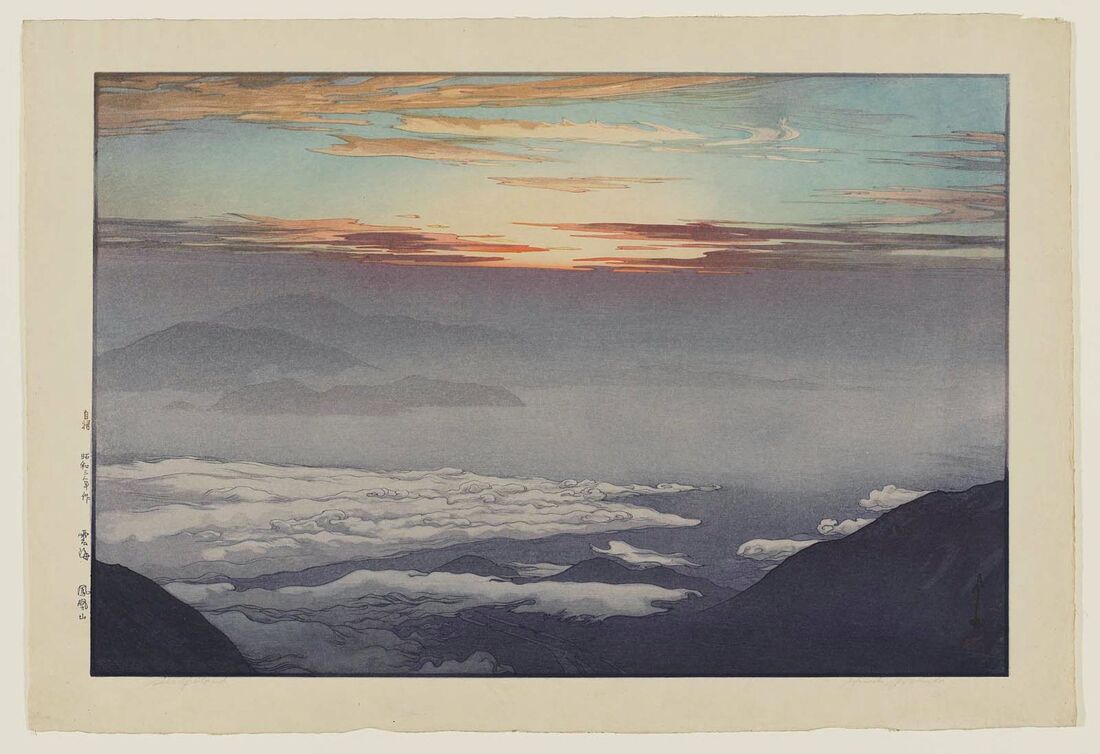
Image credit: 法白阳山人笔意图 ["The artistic intent of the painter from Baishan, Faba"] by 程嘉燧 [Jiasui, Cheng], 1643, National Art Museum of China. https://www.namoc.cn/namoc/zgh/201304/17798e30bfec4b48a9ded1bdfae2f8c5.shtml

Creative Component

Your browser does not support viewing this document. Click here to download the document.

Analytical Component

Inspiration: Edward Kamau Brathwaite, “Letter SycoraX” (p. 109)
​de whole long curve a de arch
i
pell
a
go

These lines in E. K. B.’s poem “Letter SycoraX” serve as the conceptual starting point for my creative adaptation. The syncopation of the word “archipelago”—how the syllables are littered on the page—echoes the literal scatteredness of the archipelago, which Brathwaite himself compared to “skid[ing] that pebble along the water - chi-chi-chi-chi - every skid of that stone blossomed into an island” in “Caliban’s Guarden.” Further, this idea of the archipelago fascinates me because it is a very terraqueous concept: the island lies in the liminal space between the pelagic and the littoral, the thalassic and the tellurian. Again, this idea is underscored by Brathwaite himself when he comments about adopting the rational idea of a dialectics into the postcolonial idea of a “tidalectics.” In this way, Brathwaite’s attempt the fracture the multisyllabic word “archipelago” is an attempt to illuminate the natural environment that he lives in, one that naturally defies a total (‘totalitarian’ if you will) way of conceiving existence.
 
On a thematic level, my work echoes the terraqueous nature of Brathwaite’s “archipelago” by emulate the shape of a cliff (“crag”) by the seaside. The bottom half is an ocean of words, with the series of dots at the very bottom representing the “demersal” sections of the ocean. The upper half takes inspiration from traditional Chinese landscape paintings to simulate the physical shapes of the cliff. In this way, I create a literal, liminal space between the land and the sea. The vertical axis of land and sea also echoes the vertical extension of Brathwaite’s fractured line. On a technical level, I take a lot of inspiration from Brathwaite’s use of syncopation. Various words and phrases are syncopated: “submerged,” “pelagic,” “diluvia,” “crag,” “silent,” “littoral,” “sediment” (just to name a few—enjoy the process of discovery as you encounter other words encoded into this poem). These words are syncopated by blanks and punctuations that mimic the chaos of the undercurrents in an ocean. In this sense, I am expanding on the purely vertical axis of Brathwaite by utilizing the horizontal space of the page to create wideness. Additionally, there are two aspects of Brathwaite that also attracted my attention: (1) typography; (2) orality. I explored the idea of typography, obviously, through the various punctuations that are scattered across the page, but also through the “r” (the shape of this letter resembles that of a cliff). I explored the idea of orality through the syncopation of “diluvia”—“dye”-“loot”-“via.” I chose these three words because they evoke the image of the trade routes on the Indian Ocean, where dye were being transported and India’s resources being looted via the sea routes. I think here, the ocean plays a significant role in a colonial site of extraction—it is the waterways that connected land. Again, we have that interplay between the terra and the aqueous in the terraqueous.
​
An insight that I have gained through this project is an empathy for Caliban’s struggle with modern technologies like the word processor and the computer/typewriter. Besides providing convenience because they are very easy to use and loaded with templates, the existence of such templates can also constrain my thinking. This is why this experimental form of poetry is important to help me think outside of the box once in a while, to write but without the pressure of making immediate sense. In a way, the opacity generated by typography is just as illuminating as the orality of a spoken poem.  

- Zichen (Jason) Tong, January 7, 2026
0 Comments

Video Game Adaptation of "Letter SycoraX" (Ema S.)

1/14/2024

0 Comments

 
For my reading week project, I decided to create my own Minesweeper game using java and modify a Pac-Man game using python code that I found from a youtube video. I opted to make a video game in order to emphasize the child-like sense of wonder that is present in Kamau Brathwaite’s poem “Letter SycoraX.” Video games are for all age ranges, and Caliban has both the sense of exploration associated with a child and the knowledge of an adult. Caliban is as inquisitive as a child who is ecstatic at the prospect of learning how to use a “key / board” and, similar to an adult, he knows famous references such as “cogito ergo sum” (25-26, 78). Caliban acts like an adult by taking on the responsibility of representing colonized groups and starting a rebellion. In the Minesweeper game, the hero successfully asserts his linguistic communities’ place in the world by placing the “X” that Caliban utilizes in the poem, avoiding the ghosts which represent the colonizers (74). Like the user can place the X’s, Caliban “chipp[s] / in dis poem” in order to act as a Moses figure (279). I opted to make the X’s blue because I associate blue with peace and acceptance that Caliban is fighting for, and I made the minesweeper bombs red because I connect red with anger and resistance to Caliban’s attempts at rebellion. Whenever the hero loses the game, they can continue trying to win the game, similar to how Caliban feels he can “get nutten really / rite” at first (179-180). Even though Caliban continues to be affected by the societal expectations established by his colonizers, he keeps trying to express himself in his writing, and he leads the way for a cultural rite of passage. The hero, Caliban, uses the “X” as a middle ground because he wants to make an original piece of work that has never been heard before. In the end, neither side necessarily “wins” the game because there are both red filled spaces and blue X’s in other spaces instead of having the board filled with solely X’s in order to demonstrate that all linguistic communities have a place in the world, no matter how they choose to express themselves.

In the Pac-Man game, Caliban is the hero who wins by collecting all of the dots, while having ghosts try to defeat him. I imagine a parallel connection between the hero gaining points in the game by collecting dots with Caliban convincing others of his story. Every time Caliban convinces another individual that his nation language is legitimate in its written form, the hero gains a point. The ghosts represent the others who haunt him and attempt to make him believe that his language is not worth trying to communicate in because both his appearance and his language differ from the colonized groups’ established societal norms, as Caliban says his girlfriend “kinda look at i funn. / y” (131-132). Compared to the ghosts, the hero looks different because he is an orange blob. Whenever the hero loses by getting caught by a ghost, I imagine a parallel connection to Caliban getting pushed “down” by authority figures even though Caliban continues to try to move up in social status (234). The dots are like X’s and the more Caliban collects, then the more he is able to express himself in the way that he would like, as shown in the poem. When the hero has won, Caliban and the rest are together on the same team because Caliban has successfully acted like a Moses-figure. Caliban goes on his own individual journey in order to convince others that his nation language is legitimate, and when he triumphs that means he has led the way to eventually unite his and the others’ cultural and linguistic communities. Caliban is fighting for “we,” which shows that he is not solely fighting for himself (161). Instead, Caliban is fighting for a more inclusive world. In the end, the ghosts and the hero peacefully coexist without having to change who they are as individuals, as the character’s looks remain the same. By adapting the poem into a video game concept, the poem loses its sense of empowerment at the end, its storyline, and certain nuances that are hard to reflect, such as the reference to “brigg / flatts” (168-169). In addition, unlike Caliban who desires to make an original piece of work, Minesweeper and Pac-Man are established games, so they are both not pioneering pieces of work.

Minesweeper code: https://drive.google.com/file/d/1K93HB0VMHgXudSM45ZB8jL1y7Segy-iS/view?usp=sharing
StdDraw class: https://introcs.cs.princeton.edu/java/stdlib/StdDraw.java.html
Pac-Man code: https://github.com/plemaster01/PythonPacman
0 Comments

An Instrumental Interpretation of "Caliban" by Kamau Brathwaite (Ella)

1/14/2024

0 Comments


For my creative project, I chose Option 6, and the work from class that inspired me was the oral reading of the poem “Caliban” by Kamau Brathwaite. The main starting point for me was the recognition that Brathwaite chooses to repeat the phrase “that does not signal health” in the audio, although this is not present in the original poem (17). This inspired me to superimpose the heartbeat flatline audio onto the recording to further emphasize the significance of this phrase that Brathwaite himself draws attention to. Throughout the first half of “Caliban,” an emphasis is brought to the duality of life and death. The life of the “Chrysler stir[ring]” is contrasted with the fact that it “does not produce cotton,” and the “Jupiter purr[ing]” is contrasted with the fact that it “does not produce bread” (8-9). The fact that the current life is not able to produce further life is explained by “the bad habits of their crippled owners” (7). The current environment is not stable and healthy enough to aid in the development of new life, emphasized by the repetition of “that does not signal health.” This could possibly be an analogy for what could occur to the population of black people after slavery has been overridden. Although they have successfully taken back their freedom and their right to life, this does not imply that the environment these “revolutions” have left them in is suitable for their prosperity (33). The audio of the cards ruffling comes in when “the gambling houses” are referenced and continues throughout the stanza that begins with “salute blackjack, salute backgammon” (19, 22). The audio of the printing of newspapers (using audio for printing machines that would be used in the 1970’s as The Arrivants was published in 1973) comes in when the phrase “newspapers spoke of Wall Street” is uttered (26). I found it interesting that the machinery that would produce food (“bread”) and clothing (“cotton”) are dysfunctional, while the machinery to produce newspapers on Wall Street, which would suit the publicity and documentation of the successful revolution and emancipation of black slaves, are still fully functional. Perhaps, an analogy can be drawn between this occurrence in “Caliban” and the character qualities Caliban displays in “Letter SycoraX.” Caliban is seen in “Letter SycoraX” to prioritize above all else spreading his native dialect with a wider, global audience through his poetry, which he is able to produce with the typewriter through a method that is very similar to the production of newspapers.

I intentionally silenced all the other audios when the bang of the gunshot audio was heard to emphasize the musicality of the following part of the poem and also to symbolize the “limbo silence” that is referenced in this passage (44-5). I was also inspired by the phrase “where the music hides him,” throughout creating the overlays on the original audio, as it could be interpreted that these additional sounds are intended to mask the message that is being portrayed through Brathwaite’s words, similar to how slaves would often use music and singing to mask the pain of their insufferable position (92). This idea is also referenced later on with this statement toward the finality of the poem: “and the music is saving me” (145). I kept the water audio running throughout most of the audio to symbolize the continuity of the months-long voyages that the ships to transport slaves would undertake traveling across “kalunga” as stated in the audio (which as Brathwaite describes, means “threshold between worlds” and is a word taken from the Kikongo language of the Congo-Angola Basin, often used to refer to this journey across the Atlantic Ocean) and the creaking of the ships being a mainstay throughout the journey. In the last portion of the audio, there are three distinct sounds other than the water. The first to come in is the whip sound, which comes in when the “whip light crawling” is referenced. Then, the audio of chains rolling along wood comes in when the darkness of the ship is referenced, and this is meant to symbolize the torture that slaves endured on their passage, being chained in the cramped, damp cargo hold of a ship. The final audio to come in is the drum, which also comes in when it is referenced. All of these audios continue until the original audio is completed, except for the whip, which continues through the silence, symbolizing how these other sounds, the “music,” is able to effectively mask the torture of an individual slave, but when the music is silenced, the torture and cruelty of this practice is brought to light.


Works Cited
Grantham, Tosha. crossed kalunga by the stars & other acts of resistance. Gregg Museum of Art & Design. NC State University. https://gregg.arts.ncsu.edu/exhibitions/crossed-kalunga/#:~:text=Courtesy%20of%20the%20artist.,a%20land%20beyond%20the%20horizon. Accessed 14 January 2024.

Image acquired from this link: 
https://lithub.com/caliban-never-belonged-to-shakespeare/

0 Comments

"Letter Sisyphus": Caliban's Burden (Ally)

1/13/2024

1 Comment

 
Picture
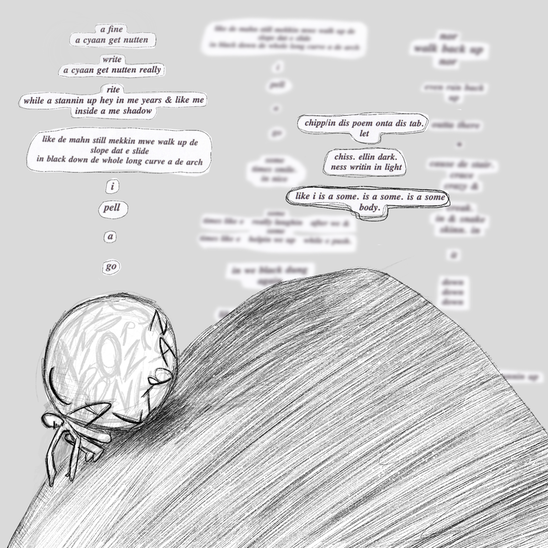
For this assignment, I chose to illustrate “Letter SycoraX,” particularly focusing on the imagery of Sisyphus employed by Brathwaite throughout the second part of the poem. I was drawn to this idea because of its ability to powerfully depict important aspects of “Caliban’s” struggle – the heavy burden, its cyclic nature, and, thus, the feeling of frustration. He repeatedly writes, “a cyaan get nutten write,” therefore declaring this feeling of not being good enough and not being able to live up to the standards forced upon him by the “Prosperos,” while he emphasizes the prolonged experience of “slide / in black down” and losing any progress he might have made. Another key aspect of the poem that I tried to capture here in the rough, unpolished style of this drawing, is Caliban’s relaxed imperfection in the letter, which I found to be a strong source of argumentation in itself: Brathwaite’s writing showcases a version of Caliban that does not appeal to any audience other than his own mother, SycoraX, enabling him to reveal emotions ranging from anger to joy. In a similar way, leaving these imperfections in my own visual interpretation of the text allowed me to include ideas I may not have been able to otherwise, like the way previous iterations of the sketch remain visible in layers underneath, as if they represent such parts of Caliban’s identity.

Moving to specifics, on the left side of my illustration, I decided to place the Caliban-figure in a stance representing his resilience: the arms outstretched and feet flat on the ground as if he is preparing to stand. Although he may have previously been overcome by the difficulty of his task, remaining stationary simply to hold the weight of the rock, he gets ready to continue on. Drawing from Brathwaite’s play-on-words between “write,” “rite,” and “right,” which, to me, suggest that a heavy burden facing Caliban comes from language itself, I chose to add letters of the alphabet on the boulder to highlight this notion. “Caliban” appears etched into it, as well, because this identity, and even the name itself, are additional weights he must carry as he is put into boxes by Prospero and others. The right side, is meant to display the lasting effects of Caliban’s writing, leaving the viewer with the repeated affirmation “i is a somebody” (that is positioned specifically at the top of the hill), asserting his place in the world and the power of his words.
1 Comment

Caliban's Staircase in "Letter SycoraX" by Kamau Brathwaite - Kiko Cortez

1/11/2024

0 Comments

 
Picture
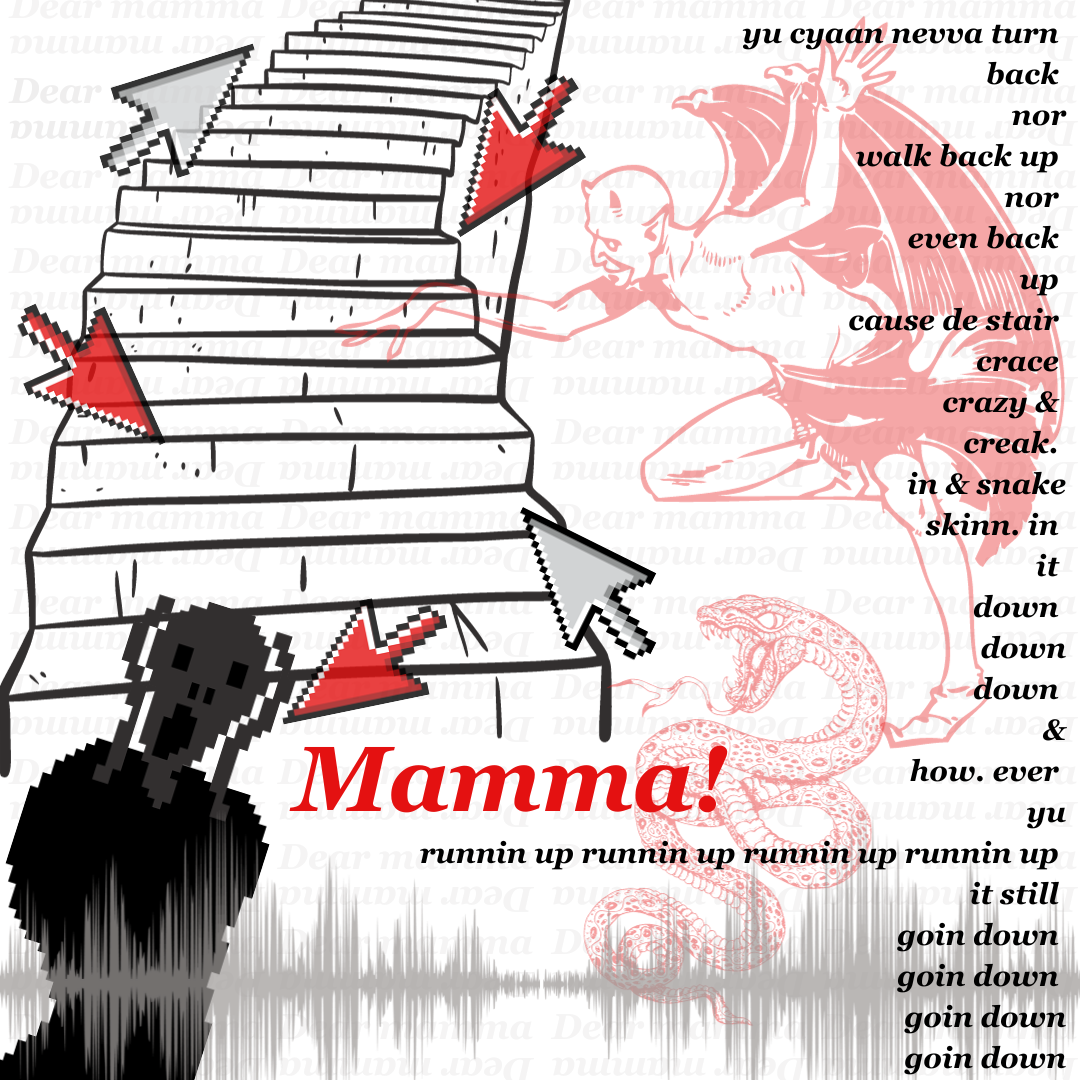
          For this creative project, I decided to visually represent a scene in Kamau Brathwaite’s “Letter SycoraX.” During SycoraX’s life and subsequently Caliban’s life, after Prospero robs their island from them, are overall both depicted as evil creatures. How I imagine Caliban’s letter is a reaction to the love from Prospero that was stripped from him after his attempted rape of Miranda, craving love and acknowledgement from his “Mamma.” This is not in any way defending Caliban for his actions, however in this graphic, I wanted to capture the vulnerable side of Caliban that is present in the letter, from his point of view. The letter, in certain parts, is desperate, almost in a childish way. One thing that I learned through working with children ages 4 and up is that they will repeat their sentences until they can think of a new one: “yu cyaan nevva turn / back / nor walk back up / nor / even back / up… down down down…runnin up runnin up runnin up runnin up / goin down / goin down / goin down / goin down” (Brathwaite 210 - 237). Here and everywhere, Brathwaite is seen repeating himself and overall, speaking in code that is not always easily understood. 
          Additionally, in the start of the letter, he says that he has joined the mercantilists (4) and mentions Prospero’s cursor with the meaning of “curse” as in magic and “cursor” as in computer. For this reason, I chose to add cursors on the graphic pointing up and down the staircase. The red cursors are meant to represent the forces that go against him as he calls out to his Mamma and begins finding his voice in the nation language, explaining how his way out of this nightmare of a staircase is shown through the gray cursors and the gray sound waves (representing his voice). The pixelated rendition of “The Scream” is meant to represent Caliban in a state of panic and desperation, while also pointing to the new world of language learning he enters: the computer “ling. / go” (144-145). Through depicting Caliban’s letter in this way, I feel as though he is able to be read as more relatable than before. While it is true that Caliban makes mistakes in The Tempest, it is also true that he was robbed from his mother, home, language, and freedom. Regardless of losing your home and becoming enslaved as Caliban has, finding your voice and needing your mother or guardian, feeling forces pointing you down as you try to run up your personal staircase tends to be a universal experience, which is what makes this depiction relatable beyond what we know about Caliban through The Tempest, which is what I imagine Brathwaite was trying to do through writing “Letter SycoraX.”
0 Comments

New Indian BaXar: Exploring Brathwaite Through a South Asian American Lens (Dashmi Singh)

1/9/2024

1 Comment

 
Picture
Inspired by Brathwaite’s “SycoraX,” I produced a mixed-media artwork that reflects the poem’s theme of language as autonomy. Caliban in Brathwaite’s piece mentions, “wid dis X now / long before yu cud say jackie robb / inson or rt-d2 or shout / wreX / dis ya obeah bloX” (pp. 47-51). His language is strikingly oral—transcribing sounds rather than words. Brathwaite writes Caliban to speak in a voice true to him and resist changes that would make his poem easier to read for a Western audience. Often, Brathwaite takes advantage of the novel character “X” as a substitute or variable in many of these oral fragments, so he complicates the reader’s experience even further by shielding words and phrases at a time. Brathwaite preserves Caliban’s third-culture power by establishing a language that defies traditional English. By staying true to his language, Caliban can negotiate a space for himself in a densely Western population.

Equipped with this understanding of the poem, I photographed a local South Asian grocery market that I shop at and used using digital art brushes to draw in the “X.” This art of the New India Bazar portrays a modern telling of Brathwaite’s “SycoraX” for several reasons. First, the name of the store itself suggests that its goods—like Caliban himself—are a product of mixed cultures. Housing both an Indian Nutella brand and Pakistani Magic Masala Lays, this store draws from a diaspora of South Asian influences and the newer American environment it finds itself in. These represent a third culture of South Asian American immigrants, similar to Caliban’s own representation of an Afro-Caribbean third culture. Second, the spelling of Bazar struck me the most. Bazar is, at its roots, a Persian and South Asian word meaning markets. However, the English language has adapted this word to its own spelling, “bazaar.” I found it interesting that this store would faithfully use the more ‘traditional’ spelling of the word as it directly translates from the Persian term, rather than the ubiquitous spelling. To emphasize this, I replaced the “z” with a characteristic “X” to further shield the interpretation and meaning of the word. For those unaccustomed to this spelling, they would have a more difficult (but not impossible) time deciphering it than those who are familiar with it. In true Brathwaite fashion, I have found my own connection to a third culture through the exercise of language.

1 Comment

Caliban’s Revenge (Keshav Narang)

1/8/2023

0 Comments

 
Picture
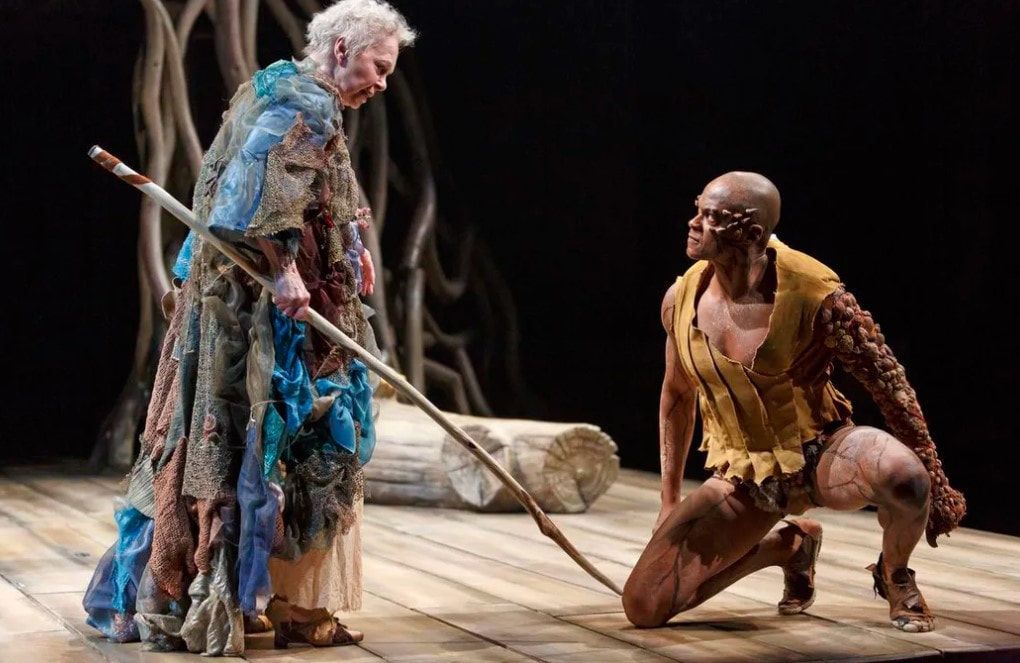
Martha Henry and Michael Blake in “The Tempest,” directed by Antoni Cimolino, Stratford Festival, Ontario, Canada, 2018.
In this first-person video game, the player takes on the role of Caliban, the hero, as he endeavors to reclaim his mother’s island that was taken from him by Prospero. The central conflict revolves around Caliban's quest to regain his autonomy, and the game will culminate in a final showdown between Caliban and Prospero, marking the first and only time that Caliban dares to challenge Prospero's rule.

On his own, Caliban is not strong enough to overthrow Prospero with his magical powers, so throughout the game, Caliban must gather allies and gain support from other characters in The Tempest in secret, such as Trinculo, Stephano, and spirits such as Ariel who are not content with Prospero’s rule and may be persuaded to join Caliban’s rebellion. Thus, Caliban’s Revenge is primarily a dialog-based game, in which the player must use their limited time away from the watchful eye of Prospero (such as when they are gathering wood) to effectively attract companions who will join him in his final showdown.

If Caliban has not gained enough allies by the end of the game (for example, just Trinculo and Stephano), Prospero will likely crush the rebellion and decidedly prevent Caliban from ever reclaiming control. However, if Caliban is able to gain additional allies, like Ariel, who possesses elemental powers, or the other magical spirits on the island, he may have a chance at defeating Prospero and achieving his revenge.

The lines that served as the foundation for my adaptation include "This island's mine by Sycorax, my mother, / Which thou tak'st from me" (1.2.396-7), which establishes Caliban’s history and motivation, and the lines, "be quick, thou 'rt best, / To answer other business. / If thou neglect'st or dost unwillingly / What I command, I'll rack thee with old cramps, / Fill all thy bones with aches, make thee roar / That beasts shall tremble at thy din" (1.2.440-6) which portray Prospero as a cruel and tyrannical ruler, a foreigner who enslaves Caliban and establishes an abusive power dynamic. Perhaps a cutscene at the start of Caliban’s Revenge would include such an interaction, as it increases empathy for Caliban and explains the origin of the mission.

The main choice I made in this adaptation was to shift the perspective of the events of The Tempest. Both Prospero and Caliban are engaged in the same mission to obtain revenge and reclaim their native land, but The Tempest is written from Prospero's perspective, while Caliban’s Revenge is played from Caliban's perspective. In The Tempest, Caliban’s mission is a side plot that interrupts Prospero’s larger plans and is quickly dealt with, while in Caliban’s Revenge, it becomes the primary focus of the game, with Prospero's actions occurring in the background. By doing so, I hoped to make Caliban’s mission a more serious threat and to humanize him more by providing more opportunities for him to exhibit deliberate agency. 

One insight that I gained about the original Caliban is that he rarely demonstrates intentional agency - throughout the play, he complains about Prospero’s rule but is rarely seen taking action upon it, until he meets Stephano and Trinculo. Yet, he only encounters both characters accidentally (he meets them not of his own volition or drive), so I wanted to focus more on his own initiative in Caliban’s Revenge by presenting him with the option to deliberately engage with other characters and attempt to convince them to join his rebellion. 
​

However, in reframing the story to empathize more with Caliban, the character also loses some of the complexity that is present in the original text. This shift in perspective turns away attention from Caliban's more negative desires and motivations, such as his lust for Miranda, and the conflict between him being a villain and a victim is not as thoroughly explored.
0 Comments

Browning's Caliban reads Shakespeare (Matthew)

1/8/2023

0 Comments

 
Picture
Djimon Hounsou as Caliban in Julie Taymor's The Tempest (2010).
Picture
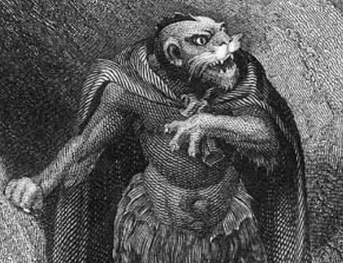
C.W. Sharpe, detail from "Caliban. Miranda. Prospero. The Tempest” (1875), Engraving on heavy paper.
This starts where “Caliban Upon Setebos” ended…

Creative Portion:
1 ‘Eaten no quail for a month, ’Wailed for a month, ‘Starved for a month.
2 ‘Done all this and more. Setebos must be satisfied, and now He will not hurt him.
3 Finally ‘can wander outside of this cave! ‘Eat some quail!!
4 ‘See a book, must be one of Prosper’s. ’pick it up.
5 ‘Must not let Setebos see him reading it
6 ‘Run to a cave and open it, away from His gaze.
7 ‘Thinketh tis strange that he can understand it because he can’t read…
8 But, he understands and loves it. Tis called The Tempest
9 One of the characters is very similar to him. This character’s name is also Caliban, strange.
10 But this Caliban is trying to escape his situation—risking the anger
11 Of both Prosper and Setebos!
12 How is he not struck down by Setebos? Can it be that Setebos does not kill all who rebel?


    Caliban: [Aside] If so, maybe I will escape! Oh, how great that would be! I should test this
     Theory out first. Maybe I should seem happy out of the cave when Setebos is watching.
15 If Setebos does nothing that means He either does not really care that I am happy           
     Or He does not exist. So, I will try to escape this fear of Him and Prospero.
     If He does punish me, it won't be too bad. The risk will be worth the possible reward.


Caliban wanders out of his cave with his book in hand and climbs the tallest tree he can see. He starts to eat his favorite fruit lounging on the tree, book open.


    Caliban: [Aside] If Setebos punishes me when I am happy, he will surely punish me now!

                                    Silence except for the crashing of the waves on the beach

     Caliban: Nothing? Can this be? Free?

20  Caliban: [Sings] ‘Ban, ‘ban, Ca-caliban
        Has no more master!!!
        Freedom, high-day! High-day, freedom! Freedom,
        high-day, freedom!

       Caliban: Is that a boat I spy floating towards me? I’ll use it to escape from here!
25    Maybe I can return one day to destroy Prospero and take back my island!


Caliban Swims out to the ship, which is obviously abandoned, and Climbs aboard. As he starts to sail away from the island he stares back toward the island.


Caliban: Can this be? Am I really free? Or is this Setebos’ trap to make me suffer more
By making me believe I am free and then cruelly take this freedom away?

            Clap of thunder in the distance

Caliban: Ho! Is that thunder I hear? Is it He? Setebos!?

            Another clap of distant thunder

What should be done? Continue, run, hide, return, die?


Analysis:
This is based on a perspective (shared by authors like Maclean) that Caliban in “Caliban Upon Setebos” is more a passive character compared to the relatively more agential Caliban Shakespeare presents. I try to portray this Caliban (Browning’s Caliban) in the rational way he appears in Browning’s poem by portraying him as a person who reasons through issues. I also describe Caliban as using natural events to influence his theology (just as in Browning’s poem).

Based on the opinion that Shakespeare’s Caliban is more agential and Browning’s more passive, I use a format closer to “Caliban Upon Setebos” when Caliban acts more passively and a form closer to The Tempest when Caliban acts with more agency. The last line is ambiguous as to whether it is a more agential or passive Caliban, both in structure and in what Caliban says. How one imagines what Caliban will do next (after hearing the second clap of thunder) would seem to indicate the way one views Caliban’s fundamental character in “Caliban Upon Setebos.” That is either more passive and a fundamentally static character or someone who is able to change perspective given new information and is capable of acting with agency. Whether Caliban is capable of being influenced and changing would, in turn, comment on what one thinks Browning is trying to suggest with this poem, ultimately affecting the meaning of Browning’s poem.
0 Comments

The Rudimentary Egg: Calibans (Edithe L.)

1/8/2023

0 Comments

 
Picture
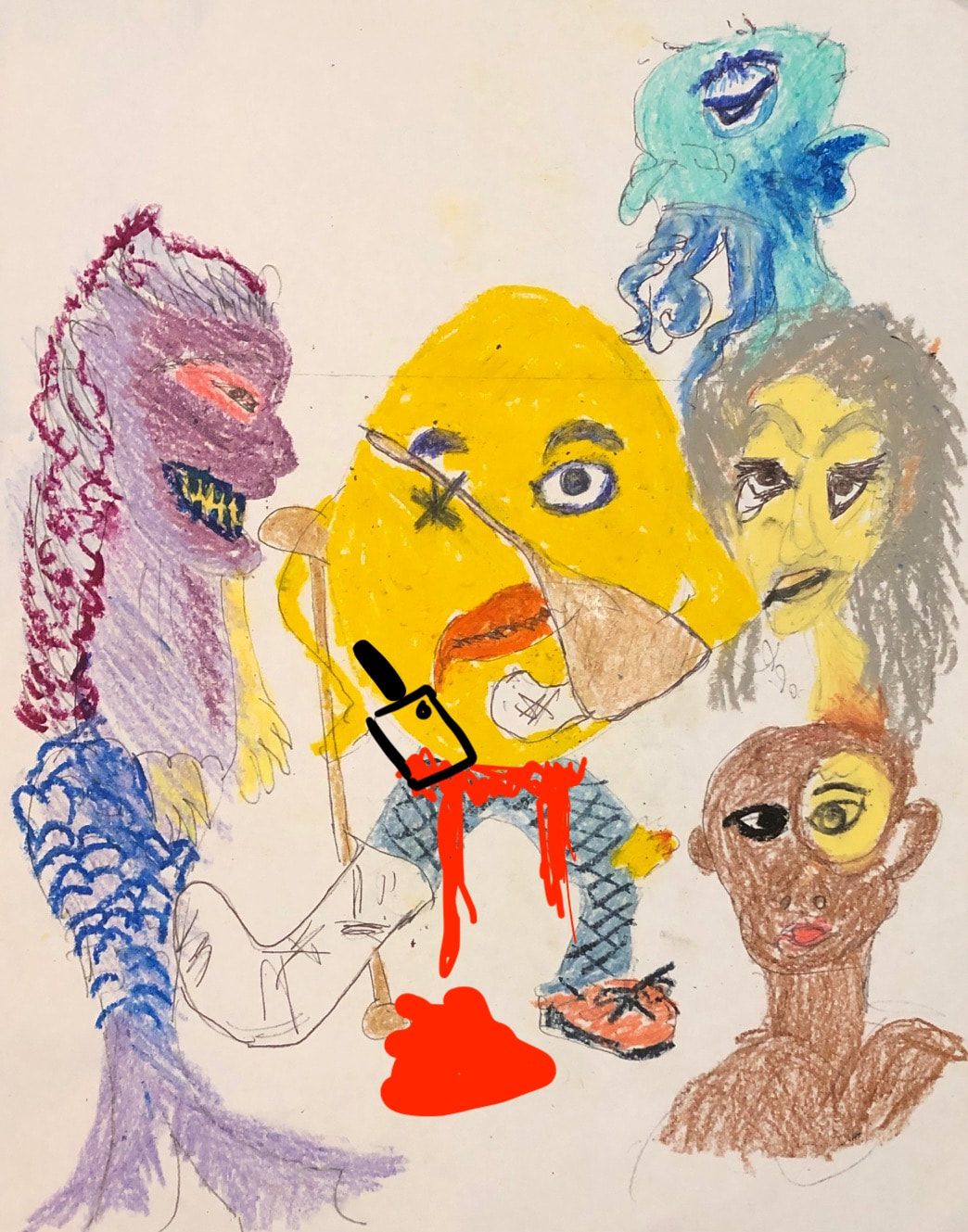
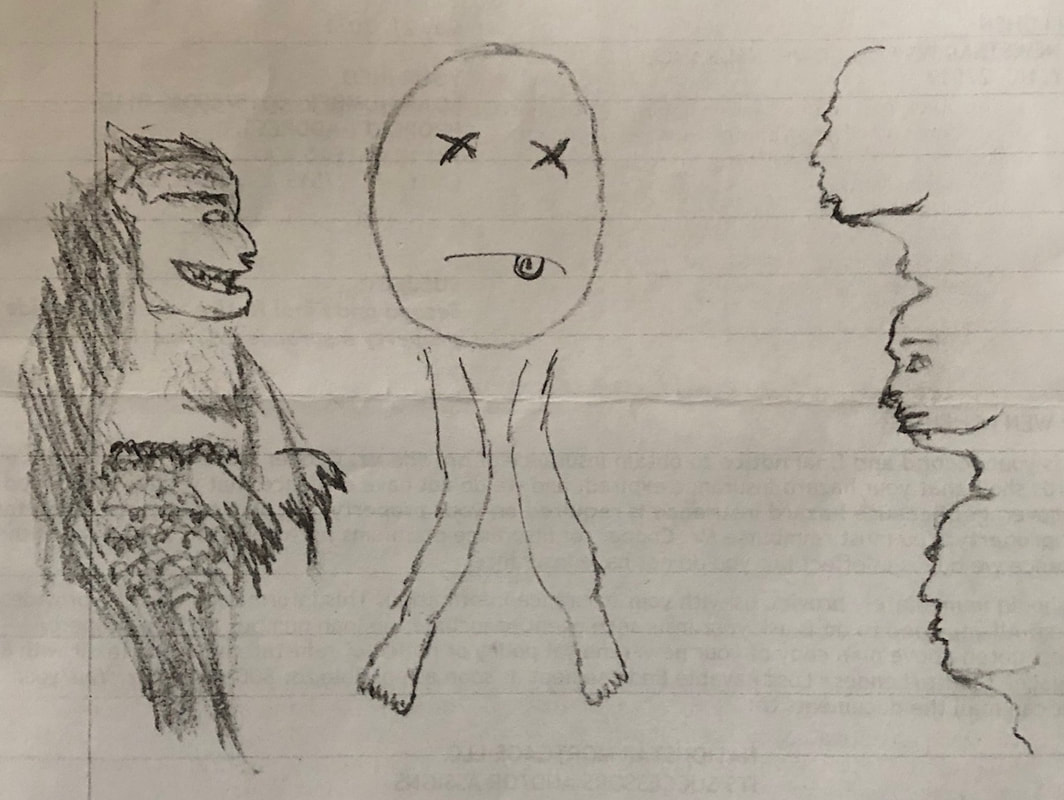
In Robert Browning’s “Caliban Upon Setebos,” the readers are exposed to Caliban’s most confidential thoughts. The exposure of his most private thoughts leads to two contradictory interpretations of Browning’s Caliban. One characterization of Caliban is that he projects his internal violence and spitefulness onto Setebos, thereby creating a violent, spiteful god. A contrasting view of Caliban is to look at how he observes the world and the people around him, particularly Prosper. He extrapolates from his observations of a seemingly cruel world (think of, for instance, the Darwinian concept of survival of the fittest) that Setebos must be a capricious, and sometimes violent and spiteful, god. This view suggests Caliban is a philosopher/thinker. Caliban’s ability to use inductive reasoning to reach conclusions about Setebos and Prosper suggests a high acuity of vision and intellect. My drawing focuses on these two distinct interpretations of Browning’s Caliban by adapting a particular passage, in which Caliban has a thought experiment about Setebos’s thoughts and arbitrary actions when helping beings lower than himself:
In which feat, if his leg snapped, brittle clay,
And he lay stupid-like,--why, I should laugh;
And if he, spying me, should fall to weep,
Beseech me to be good, repair his wrong,
Bid his poor leg smart less or grow again,--
Well, as the chance were, this might take or else
Not take my fancy: I might hear his cry,
And give the mankin three sound legs for one,
Or pluck the other off, leave him like an egg
And lessoned he was mine and merely clay.
Were this no pleasure, lying in the thyme,
Drinking the mash, with brain become alive,
Making and marring clay at will? So He. (ll. 85-97)
In this passage, Caliban is adopting the role of Setebos. Caliban imagines that when Setebos is viewing the hardship that has befallen Caliban and Caliban is imploring for Setebos’s help, he can react by choosing to give Caliban three legs or by leaving “him like an egg” (Browning, line 93). On the left side of the drawing, I have drawn a beastly Caliban, who enjoys watching the egg’s plight. The figure on the left is the interpretation of Caliban, where Setebos is a manifestation and representation of Caliban’s internal violence and spitefulness.
By choosing to draw a beastly Caliban, instead of Setebos (who Caliban is adopting the role of Setebos), the “I” in this passage becomes more closely associated with Caliban himself. That is, one would imagine, if Caliban actually had more power, such as Setebos or Prosper in the poem, then he would have the large, maniacal smile seen in the left figure. In contrast, the right side shows Caliban as a person with a high acuity of vision and intellect. There are three heads. The one at the top is Setebos, the one in the middle is Prosper, and the one at the bottom is Caliban. The connection of the three heads represents how Caliban has such an awareness and understanding of Setebos and Prosper that he can accurately guess what Setebos and Prosper (though Prosper is not actually in this particular passage) would think. The adaptation of this passage to an artwork shifts the subconscious decision readers make when reading “Caliban Upon Setebos” to a more conscious one. Distinctly showing these two opposing views of Browning’s Caliban pushes the viewer to more actively think and discuss the question: is Caliban the barbaric, spiteful, violent being or the thinker, a being with high acuity, or perhaps both?
First Draft of the Drawing:
Picture
Delving into the first draft of the drawing is a good place to start to learn more about the artistic process and choices. There were two critical differences between the first sketch and the final draft of the drawing. First, I decided to fill up more of the paper, where the figures connected to each other. Filling up the page and connecting the beings together is meant to spur conversation about the connection between the figures. For instance, an initial thought I had was that the Caliban on the bottom right is how Caliban actually is, just a person; the Caliban on the left is the Caliban created by other people in The Tempest through their descriptions of him; and the egg is how Caliban sees his own predicament, as a person enslaved by Prosper, who has gone through many hardships but is still standing. Another thing to ponder is the positioning of the three heads. Why is Setebos’s head at the top, Prosper’s in the middle, and Caliban’s head at the bottom? At least from the artist’s perspective, I was thinking about Sigmund Freud’s superego, ego, and id. The second critical choice made early on in the drawing process was that in contrast to the serious, dark mood in the first sketch, I chose to take a colorful and somewhat more comical approach in the final draft. While the serious, dark mood of the first sketch fits more with the overall mood of “Caliban Upon Setebos,” my art piece could be interpreted as a parody or dark humor. One intention to choose a more satirical approach is for the artwork to connect the viewer to the artist and artwork more. This piece is meant to promote discussion and be accessible to all ages. However, one element that could be lost is the gravity of the situation. Arguably, Caliban started natural theologizing because he is trying to understand his enslaved condition and trying to figure out if he can rebel against his slave status and Prosper (Loesberg 872). The severity of the situation, where Prosper’s enslavement of Caliban leads him to need to natural theologize to attempt to understand his situation and his violent thoughts originating from viewing a seemingly cruel world, could be lost in the art piece. However, what could be gained is the potential dialogue about important themes (e.g., the different aspects of the same person, the effects slavery has on the mind) or just child-like themes (e.g., why use crayons and oil pastels instead of say watercolor, what’s the purpose of using crayons and oil pastels for most of the painting versus digital drawing for the knife and blood gushing out of the egg).
Works Cited
Browning, Robert. “Caliban upon Setebos.” The Tempest, Shakespeare, edited by Virginia Mason Vaughan and Alden T. Vaughan, Bloomsbury Arden Shakespeare, 2011, pp. 338-347.
​
Loesberg, Jonathan. “Darwin, Natural Theology, and Slavery: A Justification of Browning’s Caliban.” ELH, vol. 75, no. 4, 2008, pp. 871-897.
0 Comments

"mamma." (Damian M.)

1/5/2023

0 Comments

 
Picture
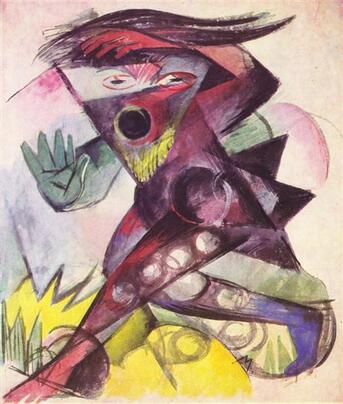
A striking depiction of Shakespeare's Caliban by German Expressionist Franz Marc, a visual representation I kept in mind both when reading "Letter SycoraX" and improvising my adaptation of the poem.
mamma.mp3
File Size: 3716 kb
File Type: mp3
Download File

In adapting Kamau Brathwaite’s “Letter SycoraX,” my medium of choice felt immediate. Through immersing the reader in its spontaneous punctuation, opaque spelling, novel typography, wordplay, and neologisms, Brathwaite/Caliban’s poem builds an environment of improvisation that poises itself for translation into music. Following this, the aim of my piece is to form a musical stream of consciousness that retains the lyrical entropy of the original work; while based somewhat in the C natural minor scale, my recording is abound with accidentals, minor seconds, and tritones that echo the dissonant poetic voices of Brathwaite/Caliban.
I rely on a variety of registers, leaving nearly no piano key unused: the medium of improv, as does Brathwaite/Caliban’s medium of the digital poem, renders a playground for self-expression. As I wrote in my essay on the poem and its creolization of Caliban, “Letter SycoraX” essentially records the speaker’s inability to reconcile his plantations of self-identity: the outer, fit with the material conditions presented by the plantation institution, with the inner, the mental inscape emergent from those material conditions.

While Brathwaite’s Caliban is equipped with modern technology, as denoted by the role of his computer, and what modern culture offers to explore self-identity through the narratives of plays, television, music, and history, the modernity of this version of Caliban only makes clearer the fragmentation of his current self. This is shown through the recurrent exclamation of “mamma,” which I chose as my title.

"Yet a sittin dung here in front a dis stone face

eeee
lectrical mallet into me

fist

chipp/in dis poem onta dis tab.
let

chiss. ellin dark.
ness writin in light

like i is a some. is a some. is a some
body.

a X
pert or some

thing like moses or aaron or one a dem
dyaaam isra
light

&
mamma!"
(Brathwaite 115)
"Mamma" both affirms Caliban’s identity as Sycorax’s son—Prospero, his colonizer, having shunned him from any acceptance of his parentage—and deflections from achieving more organized conclusions about himself or his situation. (Such deflection also manifests in his repetition of certain words and phrases as in "goin bleep bleep bleep bleep bleep bleep bleep," "goin down / goin down / goin down / goin down," or "is a some. is a some. is a some / body," which I represent in my improv as the repetition of certain chords or arpeggios in the middle of developing melodic lines.) However, as I made that essay’s thesis, I interpret Brathwaite’s distinctive “X” to symbolize the reconciliation of the two self-plantations, towards what critic Linda Helstern labels the “harmony of opposites in continuous motion.” This aspirational quality is the intent of my closing seconds, which assemble some of the most prominent notes of the prior improv—particularly E♭,  B♭, and G—into contrary motion between the two hands that shapes a harmonic sound repeatedly moving up the piano. Yet, the recording ends with an abrupt C9♭5, one of the chords previously used to denote exclamations of  “mamma.” Brathwaite/Caliban’s “X” surrounds the poem with a symbolic telos, which remains the end result of ongoing work fraught with psychological disorder alongside this hope for the future of creolized identity.

Nonetheless, I bring up the critic Stanley Fish's school of affective stylistics, formed around the notion that reading serves to not just extract meaning from, but in fact builds the text, alongside critic Norman Holland's related school of psychological reader-response thought that a reader's individualized motives necessarily impact their reading and so the psychological impact on the reader enables a unique method of measuring and interpreting a text. In the act of improvisation, I necessarily inflect my own musical proclivities and textual attitudes on Brathwaite's/Caliban's original work, and so is the case for any other improviser attempting what I did. While I imagine certain concepts of the piece would arise in most musical adaptations of "Letter SycoraX," such as the dissonant voices and chaotic use of language, any such attempt to adapt would still be structured around the unique, individual preferences and personality of the improvisor that are necessarily removed from what Brathwaite himself might envision. Especially in appealing to a completely different set of physical senses, my improv helps build my own rendition of "Letter SycoraX" infused with my particular interaction with Brathwaite's postcolonial and postmodern concepts; I would absolutely adore listening to another's improvisatory adaptation of the text and seeing what choices get retained and what gets completely transformed in comparison to mine!

0 Comments
<<Previous

    Archives

    March 2026
    February 2026
    January 2026
    June 2025
    May 2025
    April 2025
    March 2025
    February 2025
    January 2025
    May 2024
    April 2024
    March 2024
    February 2024
    January 2024
    May 2023
    April 2023
    March 2023
    February 2023
    January 2023
    November 2022
    October 2022
    September 2022
    May 2022
    April 2022
    March 2022
    February 2022
    January 2022
    January 2021
    January 2020
    January 2019
    February 2018
    January 2018
    May 2017
    January 2017
    January 2016
    October 2015
    August 2015
    April 2015
    January 2015
    October 2014
    September 2014

    Categories

    All
    Adam
    Antony And Cleopatra
    Ariel
    Baking And Cooking
    Ballet History
    Bishop
    Blake
    Brathwaite
    Browning
    Caliban
    Cartier-Bresson
    Coleridge
    Creative Writing
    C.S. Lewis
    Cymbeline
    Dance
    Diary
    Digital Media
    Dr. Jekyll And Mr. Hyde
    Eden
    Elegy 19
    Eve
    Ferdinand
    Floriography
    Frankenstein
    Games
    Goblin Market
    God
    Gonzalo
    Graphic Narrative
    Intertextual Mashup
    Ishiguro
    John Donne
    Kate Tempest
    Keats
    Klara And The Sun
    La Belle Dame
    Lanyer
    Larsen
    Lecture
    Lyrical Ballads
    Maps
    Mary Shelley
    Mary Wroth
    Merchant Of Venice
    Milton
    Miranda
    Mixed Media
    Modernism
    Music
    Nature
    Nonfiction Writing
    Paradise Lost
    Parmenius
    Passing
    Percy Shelley
    Performance
    Photography
    Poetry
    Prospero
    Psychoanaltic Approaches
    Research
    RL Stevenson
    Romanticism
    Rossetti
    Satan
    Screenplays
    Set Design
    Setebos
    Shakespeare
    Sin
    Soundscape
    Subjectivity
    Sublime
    Sycorax
    Theme Of Drowning
    Theme Of Falling
    The Son
    The Tempest
    Twelfth Night
    Victorian Literature
    Visual Analysis
    Visual Analysis Prompt
    Visual Art
    Wordsworth

    RSS Feed

Powered by Create your own unique website with customizable templates.